Showing posts with label through the decades. Show all posts

29.4.16

US vs UK :: 1880s and 1890s


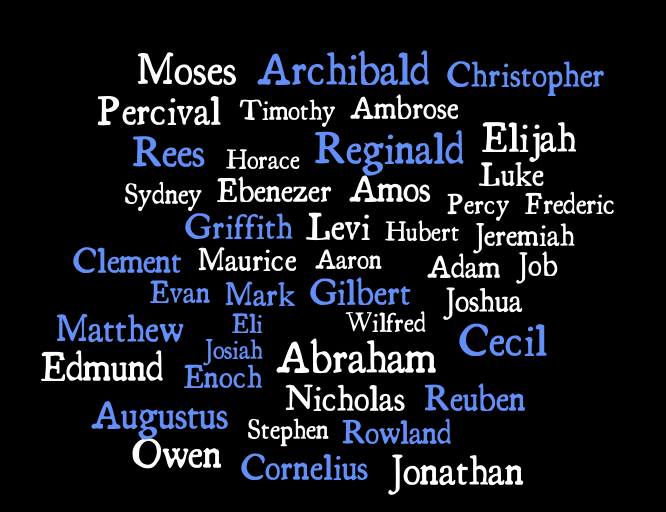
I always thought that the UK and the US popularity charts looked pretty similar. I talked to my US friends as if the same names were popular in the same decades. But when I took a closer look at the charts, I was amazed at how many names differed.

Names that were in the UK but not US popularity charts in 1880


Names that were in the UK but not US popularity charts in 1890


Names that were in the US but not UK popularity charts in 1880


Names that were in the US but not UK popularity charts in 1890


On the whole, the US names were shorter and had many more nicknames. The boys' names included names ending in -d and -er. The UK names were longer and more ended in consonants. It was interesting to see the amount of Biblical names in the 'only UK' list. This seems to have switched round now with many Biblical names in the US popularity list.

25.3.16

Alphabet Popularity


Inspiration :: Victor (painting by Victor Vasarely)

Names have popularity patterns; but their beginning and ending letters also have peaks and troughs. Here is a chart showing the letters that peaked in each decade.
Year
1st Letter
Last Letter
1880
e f g h l o w
e m a u
1890
1900
m
z
1910
v
1920
b
d s t
1930
r
1940
d p
p
1950
k s t
f g l k y
1960
c
1970
c j
w
1980
r q
1990
n
o b
2000
a
v j n x

Popular Beginnings
Below is a graph showing the year that each letter of the alphabet peaked as the first letter of a name. The letters without results are those that haven't really had a peak in popularity.


Names with Popular Beginnings
These names all have the popular initial for a year they were in the top 50. Eg. The letter V peaked in 1910 and this is also a year where Victor was in the top 50. 

1880
Elizabeth, Florence, Ellen, Emily, Eliza, Hannah, Gertrude, Harriet, Frances, Fanny, Eleanor, Esther, Grace, Louisa, Lily, Lillian, Laura, Emma.
George, Henry, Frederick, Ernest, Edward, Herbert, Harry, Frank, Fred, Francis, Edwin, Harold, Edgar, Horace, Hugh, Edmund, Lewis, Willie, Leonard, Walter, William.

1890
There were no letters that peaked during this decade.

1900
Mary, Margaret, Mabel, Marjorie, Muriel, Minnie, Maud.
Michael.

1910
Violet, Vera.
Victor.

1920
Beryl, Betty,
Bernard.

1930
Rita, Rosemary.
Ronald, Raymond, Roy, Richard, Reginald.

1940
Dorothy, Diane, Doreen, Patricia.
David, Peter, Derek, Paul, Patrick, Phillip.

1950
Susan, Sandra, Kathleen, Sheila, Karen, Shirley.
Stephen, Keith, Kevin, Steven, Thomas, Kenneth, Terence, Trevor, Timothy, Stuart.

1960
There were no letters that peaked for a first initial during this decade.

1970
Caroline, Jenna, Jessica, Catherine, Joanna, Clare, Joanne, Charlotte, Jennifer, Claire
Christopher, James, Jason, Jonathan, Craig, Carl, Colin, Justin, Christian.

1980
Jennifer

1990
Natasha, Nicole.
Nathan, Nicholas.

2000
Amy, Amelia, Abigail, Alice, Amber, Abbie, Aimee.
Alexander, Alfie, Adam, Aaron, Archie, Alex.


Popular Endings
Below is a graph showing the year that each letter of the alphabet peaked as the last letter of a name. The letters without results are those that haven't really had a peak in popularity.


Names with Popular Endings
These names all have the popular last letter for a year they were in the top 50. Eg. The letter A peaked in 1880 and this is also a year where Laura was in the top 50.

1880
Grace, Amelia, Nellie, Laura, Isabella, Maria, Bertha, Clara, Martha, Louisa, Eliza, Emma, Ada, Alice, Florence, Annie, Catherine, Gertrude, Kate, Rose, Beatrice, Minnie, Charlotte, Jessie, Caroline.
William, Tom, Willie, Bertie, Horace, George.

1890
There were no names in the top 50 with the peaked letter in this decade.

1900
There were no names in the top 50 with the peaked letter in this decade.

1910
There were no names in the top 50 with the peaked letter in this decade.

1920
Frances, Iris, Violet, Phyllis, Winifred, Gladys, Doris, Margaret.
Clifford, Herbert, Francis, Bernard, Douglas, Richard, Reginald, Donald, Raymond, Alfred, Harold, Leonard, Ernest, David, Dennis, Charles, Albert, Edward, Robert, Ronald, Thomas, James.

1930
There were no names in the top 50 with the peaked letter in this decade.

1940
Phillip

1950
Carol, Wendy, Shirley, Lesley, Mary.
Michael, Paul, Nigel, Neil, Jeffrey, Timothy, Patrick, Derek, Gary, Barry, Mark, Geoffrey, Anthony.

1960
There were no names in the top 50 with the peaked letter in this decade.

1970
Andrew, Matthew.

1980
Christopher, Peter, Alexander, Oliver.

1990
Jacob

2000 
Madison, Erin, Caitlin, Lauren, Megan.
Benjamin, Ethan, Dylan, Ryan, Ben, Cameron, Nathan, Owen, Kieran, Aaron, Brandon, Alex, Harrison.


Special Names
These are the names that had both a popular first letter and a popular last letter.

1880
Eliza, Florence, Gertrude, Louisa, Laura, Emma, Grace.
Horace, George, William.

1920
Bernard

1940
Phillip

1950
Shirley
Timothy

2000
Alex, Aaron.


26.2.16

Through the Decades :: 1 syllable, Male


Inspiration :: Dale (Yorkshire Dales)

Below is a chart showing all the one syllable names in the top 100 for each decade. The names are listed in their order of popularity. For example, you can see how John is the top 1 syllable name in 1860 and 1870 but in 1964, it slips to 3rd place.


John, George and James take the the top places for a good 100 years. Others like Fred, Frank, George and Hugh were less popular but remained in the top 100 for a long length of time. Many of the name that appear fleetingly in the top 100, seem dated now - Carl, Bruce, Dale and Shane.

Modern 1 syllable names are a mix of historical (John and James) and Modern (Zain and Cole). The rise of nicknames has had a bigger impact on the boys' 1 syllable names than the girls. They are often diminutives of older, longer names such as Max for Maximillian, Ted for Edward or Frank for Franklin. The longer, older names are rarer now - sometimes we even forget that they were ever a diminutive!

Below are the 1 syllable names from the top 200 names in the UK 2014.


Below are the 1 syllable names in the top 200-1000 in the UK 2014.


14.2.16

Through the Decades :: 1 syllable, female


Inspiration :: Dawn

1 syllable names have been present throughout history - pretty, unfussy, usually nickname-proof and with less spelling and pronunciation problems, they are a popular choice for many parents.

Below is a chart showing all the one syllable names in the top 100 for each decade. The names are listed in their order of popularity. For example, you can see how Ann is the top 1 syllable name in 1860 and 1870 but by 1890, it is only the 4th most popular one syllable name for girls.


From 1860 to 1890, the names are those that we would call 'pretty but ordinary' today. Apart from Maud who now bears the weight of stigma, they are still used. Jane and Ann took the No. 1 spot whereas names like Grace were less popular. This has been reversed today - Grace is at No. 1 , Ann and Jane are not even in the top 1000 although they are still seen as plain and ordinary.


From 1914 to 1944, there was an influx of new 1 syllable names. We see a mix of the Victorian favourites with these new, 'modern' names like Jean, Jill, Joy and Joyce, J was definitely the initial letter in vogue. 1954 claims the longest list of 1 syllable names. Lynne, Lynn, Gail, Dawn and Kay entered the top 100 - the names we see as extremely dated today. 

After 1964, the number of 1 syllable names starts declining. Claire becomes the new popular name, Ann finally leaves the top 100. By 2004, many of the names are 1 syllable word names like Brooke, Jade and Faith. This is still the pattern we see today. Sky, Hope and Rae (the modern 1 syllable names) sit amongst old favourites from the 1800s like Kate, Grace, Ruth and May. I think that we will see another rise of 1 syllable names as we borrow even more words from other languages and if the nicknames culture continues. Maybe someday, even Maud will arrive back in our Birth Announcements.

Below are the 1 syllable names currently in the UK top 1000.


27.11.15

Through the Decades :: Flower Names


Inspiration :: Heather (painting of heather on the Yorkshire Moors)

Introduction
Flower names are amongst the most feminine names you can give your daughter. Arboreal and other nature names such as Rowan or Clay are used for boys but flower names are mostly exclusively for girls. They were extremely popular along with jewel names such as Ruby in the Victorian and Edwardian era and are recently on the rise. 

Method
I looked at the top 100 names four years (eg. 1904, 1924) into each decade for each gender. The following chart shows all the flower names from those years. The arrows represent the years that each name was in the top 100.


Analysis

Flower Names 
Ivy, Lily, Rose and Violet were the staple flower names in this time period and were joined by Daisy (who dropped out of the top 100 after 1924) and Iris (who continued to be popular into the 1940s). These names all have a short, simple but pretty style which is probably why they have all returned to the top 100 recently. They make great siblings to some of the diminutive names I discussed last week eg. Elsie, Lily, Annie and Rose.

By 1954, Heather was the only flower name in the top 100. However, she never reached the top 50. For this reason and the beautiful moorland associations, I think she could make a comeback in the UK much earlier than other 1960s/70s names which seem very dated today.

Names with Flower Meanings
These names appeared in the top 100 and whilst they are not the names of flowers, they do have floral links in their meanings.

May :: She is an alternative name for a hawthorn flower and appeared in the top 100 from
1904-1934.

Samantha ::  Samantha is a feminisation of Samuel with the added bonus of the -anth- element which means flower in Greek which makes her a flower name in disguise. You may be more familiar with the -anth- element in names like Iolanthe and Ianthe which relate to the violet. Samantha featured in the top 100 names from 1964-1994.

Maryam :: This Arabic and Persian form of Maria is also the word for a tuberose in Iran. She appears in the top 100 in 2014.


Conclusion
I wonder which flowers will make the top 100 over this decade. We have seen the comeback of flower names from the early 1900s and I wait in hope for the resurgence of Heather. But will parents ever be brave enough to make Zinnia and Amaryllis seem ordinary? I am intrigued to find out.

Please check out the Plato Admetus Electra Demeter pinterest board here where I will share lists and infographics related to the posts.


16.11.15

Through The Decades :: -IE Names


Inspiration :: Barrie (picture of a scene from Peter Pan by JM Barrie)

Introduction
The series of the 'Through the Decades' posts is going to look at trends of particular elements of names. This week I am starting with names ending with -ie; a popular ending usually associated with diminutives. 

Method

I looked at the top 100 names four years (eg. 1904, 1924) into each decade for each gender. The following list shows all the names ending in -ie from those years.


Analysis
Female Names :: 1900s-1930s
Apart from Marjorie, these names are the typical 'vintage' diminutives that are becoming popular again. This is easily demonstrated by Elsie who appears in the top 100 from 1904 to 1934 and reappears on the 2014 list. She started to be used as an independent name in the early 20th Century and it is often said that parents are starting to use diminutives as given names but I now feel like this is not exclusive to the 21st Century - there are many diminutives on the popularity charts here.

Female Names :: 1930s-1990s
Marie takes over from Marjorie to be the resident -ie name for this time period and there are not as many diminutives seen. Longer names such as Natalie, Valerie and Stephanie have replaced the two-syllable names from the early 20th Century.

Female Names :: 1990s-2010s
Another shift takes place towards two syllable diminutives again. There are not many repeats of diminutives but names of a similar feel like Mollie and Charlie which may have felt too informal or even too masculine (in the case of Charlie) to be written on a birth certificate previously.

Female Names :: The General Pattern
The sketch-style graph below shows the general pattern in the amount of -ie names in the top 100 for girls.


Male Names
Overall, there were less -ie names for boys. Over the first half of the 20th Century, there were one or two names in the top 100 for each decade; usually Bertie, Leslie or Barrie. In the 1970s, Jamie takes over as the longstanding -ie name for boys. As seen with the girls' names, 2004 was a turning point for -ie names. Many nicknames from earlier times are having a resurgence and are being used as given names.

Male Names :: The General Pattern

The sketch-style graph below shows the general pattern in the amount of -ie names in the top 100 for boys.

Conclusion
The general trends show a dip in popularity of -ie names in the middle of the 20th Century then a sudden rise in 2004. The same pattern is seen with the number of -ie names that are diminutives (eg. Many names in the 1940s-1980s were longer, complete forms of names such as Valerie and Sophie whereas names like Bertie and Katie are diminutives and seen in the early and more recent popularity charts.) It will be interesting to see how long this diminutive madness continues.